 Dubai Company Formation
Emiratisation targets for 2026 fall due on 31 December

Every private company in Dubai that has grown past 50 people runs on a calendar with two Emiratisation dates in it. The first, 30 June 2026, has passed. The second is the last day of the year: by 31 December 2026 a targeted company has to have completed its Emiratisation growth for 2026.
The rule for companies with 50 or more workers
The UAE Cabinet set the rate at 2 per cent a year in skilled jobs in private establishments with 50 or more employees, building to an overall increase of 10 per cent by 2026. The Ministry of Human Resources and Emiratisation splits each year in two: 1 per cent in the first half, and the remaining 1 per cent in the second half, which ends on 31 December.
What a missed post costs
The official portal describes the contribution as it began: AED 6,000 a month for every citizen not employed against the target, rising by AED 1,000 a year until 2026. On 22 June 2026 the ministry, through the Emirates News Agency, gave the current figure: from 1 July 2026, AED 10,000 a month, or AED 120,000 a year, for each position not filled with an Emirati.
Companies with 20 to 49 workers
Since 2024 the target has also reached smaller companies in 14 sectors, among them information and communications, financial and insurance activities, real estate, professional, scientific and technical activities, construction, wholesale and retail trade, and hospitality. They had to hire one Emirati by the end of 2024 and one more by the end of 2025, with contributions of AED 96,000 in January 2025 and AED 108,000 in January 2026 for those that did not. The rule is Ministerial Resolution No. 455 of 2023. The portal's page, last updated on 15 October 2026, sets out those two hires and names no third one for 2026.
What counts as a hire
The hire has to be real. The employer obtains a UAE national work permit from the ministry, signs a contract under its rules, pays through the Wages Protection System, and registers the employee for pensions within a month of the permit. The minimum monthly wage for an Emirati in the private sector has been AED 6,000 since 1 January 2026. Pension contributions total 20 per cent of salary: 12.5 per cent from the employer, 5 per cent from the employee and 2.5 per cent from the government.
Fake Emiratisation
The ministry treats fake Emiratisation as a serious labour market violation. Penalties are set by Cabinet Resolution No. 95 of 2022, and Cabinet Resolution No. 44 of 2023 added further ones for companies that get round the targets by cutting staff or reclassifying employees. Violations can be reported to its call centre on 600590000, through its app or its website.
The incentive side
Companies with strong results can join the Emiratisation Partners Club, which the ministry says brings discounts of up to 80 per cent on its service fees and priority access to government procurement. Candidates are found through Nafis, the federal programme that aims to place 75,000 Emiratis in the private sector over five years.
Where this sits in setting up a company
The rate is counted on headcount, so it is a growth question rather than a licence one: a new mainland company in Dubai meets it the year it hires its fiftieth person, or its twentieth in one of the 14 sectors. That is worth knowing at registration, when the activity on the licence decides which list a company is on.
Do the arithmetic in November, not in the last week of December. The target is a share of skilled jobs, so a company that has added skilled roles this year has a larger base than in January; count it again on today's headcount before assuming you are clear. The hire that counts is one with a work permit, a WPS salary of at least AED 6,000 and a pension registration in place, and each of those takes days, not hours, so an offer accepted on 28 December may not be a hire on 31 December. Free zone companies should not assume either way: the official page does not mention free zones, so a company whose staff hold free zone permits should ask its own authority in writing whether it is targeted. At AED 120,000 a year per missed post, a salaried role is usually the cheaper answer, and the Partners Club discount makes it cheaper still.
Emiratisation targets for 2026 fall due on 31 December: questions
What is the Emiratisation deadline in December 2026?
31 December 2026. Private companies with 50 or more workers must complete the second 1 per cent of their 2 per cent annual increase in Emiratis in skilled jobs by the end of the second half of the year.
How much is the fine for missing the Emiratisation target?
The ministry calls it a financial contribution. From 1 July 2026 it was AED 10,000 a month, AED 120,000 a year, for each position not filled with an Emirati citizen.
Do companies with 20 to 49 employees have to hire Emiratis?
Those in 14 named sectors had to hire one Emirati by the end of 2024 and another by the end of 2025, under Ministerial Resolution No. 455 of 2023. The official portal's page, updated 15 October 2026, names no further hire for 2026.
What is the minimum salary for an Emirati in the private sector?
AED 6,000 a month, effective 1 January 2026.
Related
Mainland company setup
When a mainland licence is genuinely required, and what comes with it as the company grows.
Registering a company in Dubai, step by step
From the activity on the licence to the first visa, in the order it actually happens.

Dubai free zone comparison
Which free zone actually fits an activity, compared by fit rather than ranked into a top-10.
Source: UAE Government official portal (text provided by MoHRE) checked against the source
More Dubai news

Provider accreditation rewritten
Ministerial Decision 168 of 2026 replaces the two earlier decisions on accrediting e-invoicing service providers for Dubai and the rest of the UAE. The pre-approval stage is gone, providers may use third-party Peppol products, and firms with preliminary approval had 30 days from 1 October to meet the new requirements.
Free zones get mainland access
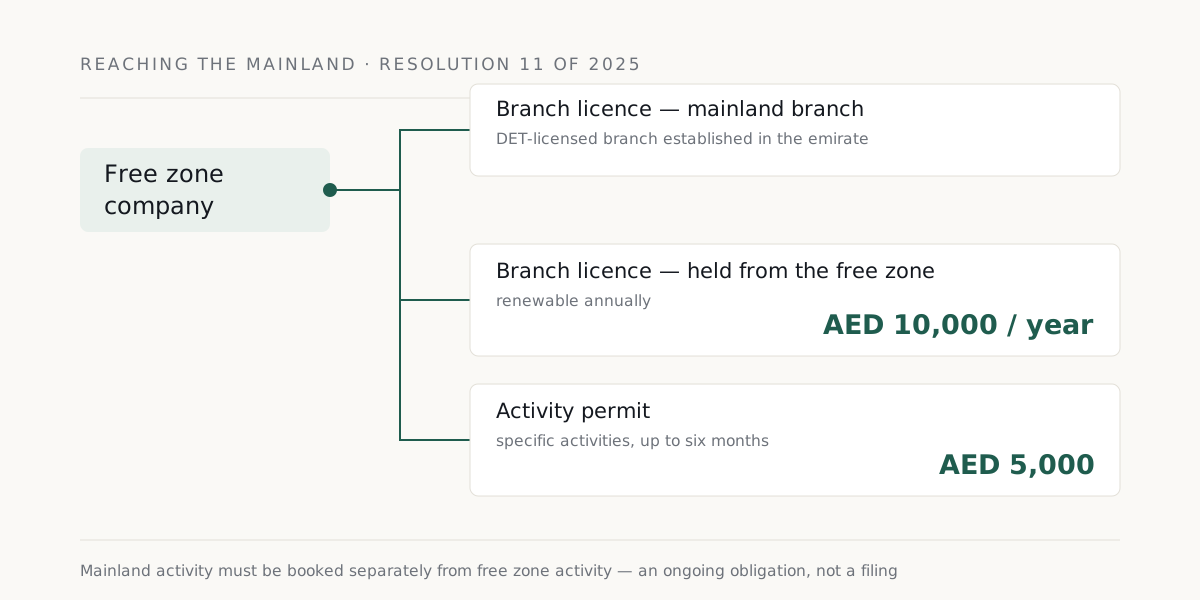
Dubai's Executive Council Resolution No. (11) of 2025 lets free zone companies trade in mainland Dubai on a DET branch licence or a temporary activity permit, instead of setting up a separate mainland company.

Tourist VAT refunds in a day
The Federal Tax Authority and Planet launched an AI-powered refund platform on 20 October 2026: tourists leaving through Dubai International, Zayed International or Sharjah now get their VAT back in one business day instead of about nine. What that means for a Dubai shop on the scheme.